
AI Complaint Triage NZ: Build a Human Handover, Not an Automatic Resolution
AI complaint triage should prepare a factual summary, link supporting messages, identify missing information and propose a responsible reviewer. It should separate customer allegations from verified facts. A person decides the response, remedy and commitments, while the workflow tracks whether the handover was accepted and flags unattended cases.
For NZ business owners, the useful question is not “Can AI write a reassuring reply?” It is “Who has actually taken responsibility?” This checklist focuses on that handover, not automatic complaint resolution.
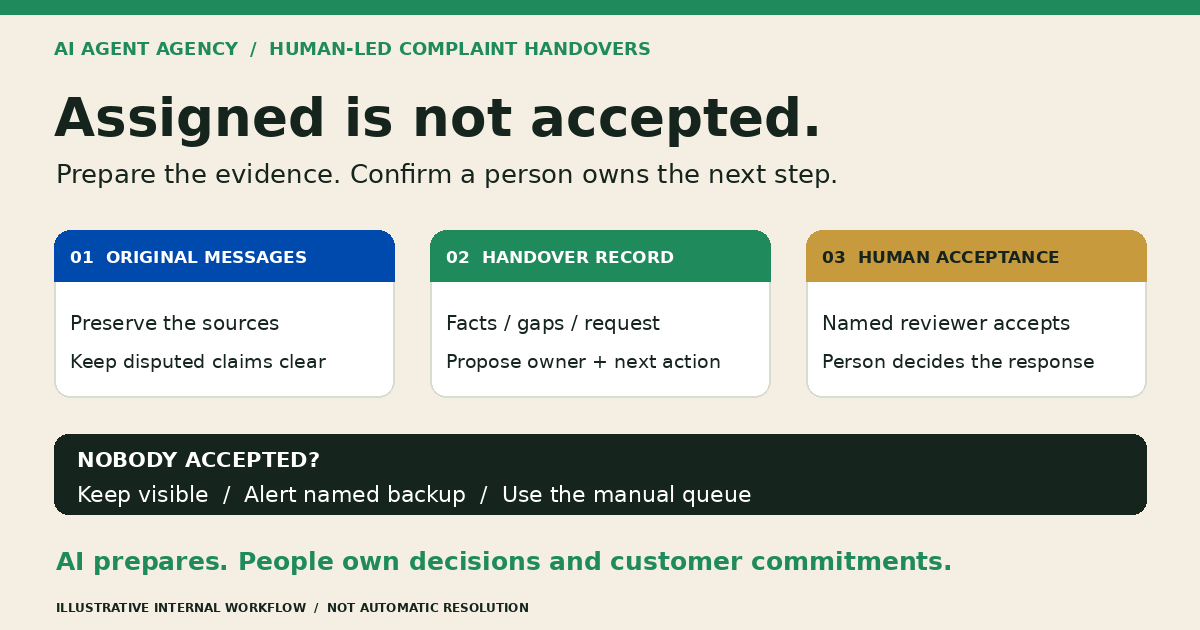
What can AI prepare—and what must a person decide?
Use AI for preparation, not a verdict. It can organise a chronology, extract the requested outcome and flag gaps against approved records. Keep refunds, admissions, compensation, case closure and customer commitments with an authorised person. The broader customer-service agent guide covers support workflows beyond complaints.
For patterns across multiple responses rather than one case, use the customer-feedback theme-to-action register. Batch analysis must not delay urgent individual handovers.
Keep the source beside the summary
Preserve original messages and attachments in an access-controlled system. Link each important statement to its source; mark missing history and conflicting accounts. A polished summary must not turn “the customer says delivery failed” into “delivery failed”.
On 6 October 2026, the Ombudsman’s AI guidance announcement warned that AI-assisted complaints can introduce inaccurate or irrelevant material. This concerns public-sector and official-information processes, not blanket requirements for private businesses. The practical lesson here is evidence discipline, not legal advice.
Create a copyable complaint handover record
Copy these fields into your restricted helpdesk or case register. Use one case ID across repeat contacts, while preserving each message. A customer should not have to retell the whole story because a ticket changed hands.
- Case and sources: Case ID, channel, received time, original-message links and relevant order or service reference.
- Chronology: Dated events, earlier contacts and recorded promises, with source references.
- Requested outcome: What the customer wants, using their wording where useful.
- Verified facts: Statements checked against named records by a reviewer; include who checked and when.
- Allegations and disputed facts: Customer account, staff account, contradictions and unverified statements, clearly separated.
- Missing information: Absent messages, unclear dates or records needed before a decision.
- Ownership and acceptance: Proposed reviewer, backup, assigned time, accepted time and accepting person.
- Next action and status: Human-approved action, internal review target, next update owner and decision history.
Illustrative example: delivery disputed
In this fictional example, a customer reports non-delivery, while a tracking record says “delivered”. Record both accounts and link the tracking event. The handover asks the operations reviewer to check delivery evidence; it does not decide who is right or promise a refund.
For an invoice-related complaint, use the purchase-order matching checklist to prepare document differences separately. A finance comparison does not settle the complaint or authorise a remedy.
Set escalation rules before drafting replies
Route by observable risk and missing evidence, not sentiment alone. A polite message can describe a serious safety concern. An angry message can still require ordinary investigation. Do not infer vulnerability from age, accent or writing style.
Define stop conditions and a human route
Flag safety concerns, possible privacy incidents, legal language, disputed commitments, repeated unsuccessful contacts and requests to speak to a person. Name the responsible role and backup before the pilot. Use your established urgent-response process for immediate risks; do not wait for an AI summary.
Use the AI agent escalation-rules guide for the wider stop-condition map and approval-gates guide for decisions that require sign-off. A routing suggestion must not become permission to send, refund or close.
Limit personal information before testing
The Privacy Commissioner’s AI guidance recommends a privacy impact assessment before using AI with personal information, updated regularly. Assess permitted sources, provider handling, access and retention before a pilot. Start with synthetic records; redaction alone does not guarantee that a person cannot be identified.
Confirm that someone accepted the handover
Treat “assigned”, “notified” and “accepted” as separate states. A sent notification is not evidence that someone read it. Acceptance should record a named person taking ownership, the next action and the next review point—not simply opening the message.
Make unattended cases visible
Choose an internal acceptance target suited to the case and staffed hours. These are your operating targets, not universal NZ complaint-response deadlines. Have the appropriate adviser identify any sector-specific obligations separately.
When acceptance is overdue, notify the backup through an approved internal route and retain the original case history. If the backup also cannot respond, surface the case to the duty owner and use the manual queue. Do not repeatedly reassign it, label it resolved or send reassuring promises while nobody owns it.
Keep customer acknowledgement separate from reviewer acceptance. “We received your message” does not mean “a person is investigating”. Only communicate a next step that the business can support.
Run four checkpoints in a shadow-mode pilot
Shadow mode means AI prepares an internal record while your existing team handles the complaint normally. It does not send replies, issue remedies, change substantive case status or replace urgent handling.
1. Agree expected outcomes first
Have a reviewer define the correct route and essential facts for synthetic or appropriately authorised examples. Include polite complaints, repeated contacts, conflicting accounts, missing history and explicit requests for a person.
2. Check evidence and corrections
Compare summaries with original records. Count unsupported statements, omitted customer requests, factual corrections and missed escalations. Check that unverified statements never appear as verified facts.
3. Rehearse an absent reviewer
Test leave, an undelivered notification and a case nobody accepts. Confirm the backup can access the evidence and a person can find every unattended case without relying on the agent.
4. Make a stop-or-expand decision
Track review effort and unaccepted handovers alongside errors. Agree acceptance criteria before expanding. If preparation adds work or review capacity is missing, fix the process first—or keep it manual.
Frequently asked questions
Can AI decide whether a complaint is justified?
Not in this preparation workflow. AI can organise accounts and source records, but a qualified person evaluates the evidence, applicable policy and response. A fluent summary is not a finding of fact.
Should AI send complaint acknowledgements automatically?
Not during the pilot. Keep acknowledgements human-reviewed. If you later consider a fixed receipt message, assess it separately, distinguish receipt from investigation and block invented commitments or resolution claims.
What if the customer asks to speak to a person?
Make that an explicit handover trigger. Preserve the request, provide your established human contact route and confirm reviewer acceptance internally. Do not force the customer through repeated AI exchanges first.
What happens if the assigned reviewer does not respond?
Keep the case visibly unaccepted, alert the named backup and follow the duty-owner or manual process if needed. Log the delay and next action; never equate assignment with ownership or resolution.
Map the workflow before enabling customer-facing actions
Use the NZ$1,000 AI Agent Assessment to map your complaint preparation and review workflow: permitted information, handover record, reviewer capacity, acceptance checks and where automation must stop.
Bring a redacted process outline, not private complaint transcripts, to the initial booking. Assessment and implementation are separate. The recommendation may be a preparation-only pilot, prepare first or do not automate. This is workflow scoping, not legal advice or emergency complaint handling.