
AI Customer Feedback Analysis NZ: From Reviews to a Reviewed Action List
AI customer feedback analysis groups reviews, survey responses and support comments into themes linked to their sources. A useful workflow removes duplicates, records the sample and date range, checks context with a human reviewer and turns supported patterns into owned actions—not automatic replies, customer labels or unsupported revenue conclusions.
For a New Zealand owner or operator, the goal is a decision you can explain: what needs investigating, what evidence supports it and who will check next. Start with one question, not a dashboard of sentiment scores.
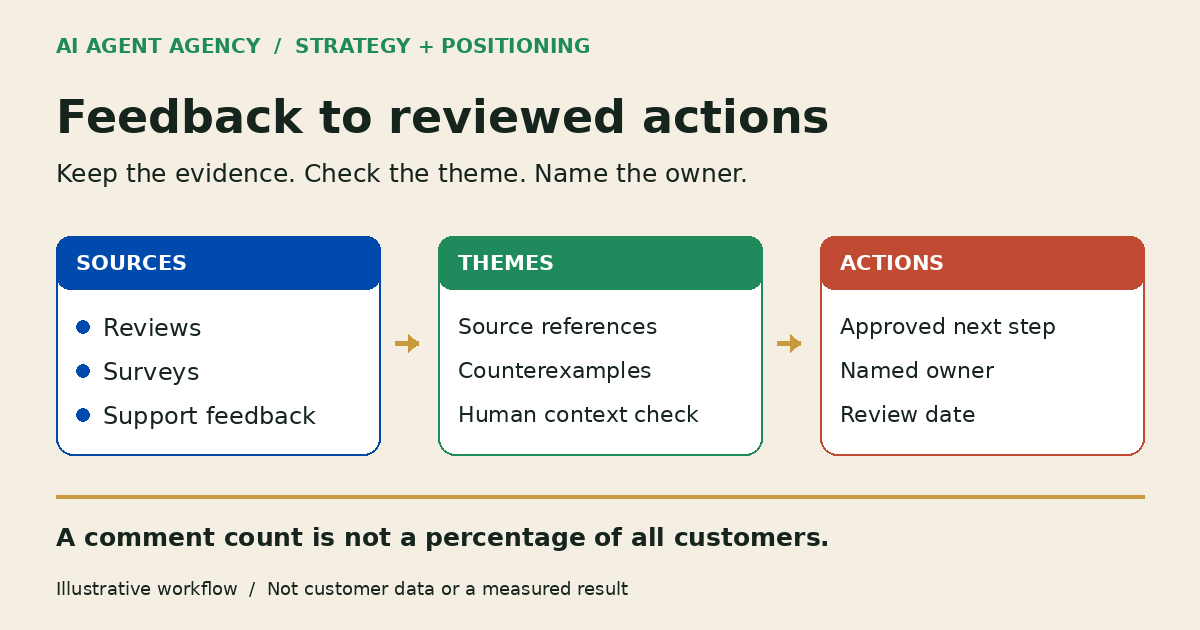
What does customer feedback analysis actually produce?
The output should distinguish three things: a theme describes a recurring subject; sentiment describes the expressed tone; an action proposes what your business should investigate or change. A negative tone does not establish the cause, seriousness or correct response.
Keep themes separate from individual cases
A batch can reveal recurring delivery questions without deciding any customer's refund. Use the complaint-triage guide for individual handovers. Urgent concerns must follow your existing human process immediately, not wait for the next analysis batch.
Allen + Clarke's ThematIQ description emphasises expert review and source traceability for thematic analysis. Those are useful principles, not evidence that AI Agent Agency supplies that product or has delivered equivalent research. The smaller workflow below is a proposed operating method.
Four steps from scattered comments to checked themes
1. Define the decision and permitted sources
Choose a question such as “Which delivery information should we clarify?” Record the date window, channels, inclusion rules and source owner. Check permission and permitted collection methods before importing reviews, surveys or support emails. Public visibility is not permission for unrestricted reuse.
Remove unnecessary names, contact details and order information. Store source passages in restricted storage; use reference IDs in the working sheet. Check provider access, retention, training settings and processing locations rather than assuming NZ-only hosting.
The Office of the Privacy Commissioner recommends a privacy impact assessment before using AI with personal information, with regular updates. Complete that review before a live-data pilot; redaction alone does not guarantee anonymity.
2. Preserve context and remove repeat contacts
Give each source a stable ID and retain its channel, date and relevant question wording. Link repeated messages about one incident rather than counting each as independent support. Distinguish unique comments from unique customers; only claim customer counts when you can establish them appropriately.
Keep channel-level counts alongside combined themes. A survey asking about delivery differs from an unsolicited review. Record exclusions, missing channels and unresolved duplicates. A feedback count is not a percentage of all customers or proof that the sample represents them.
3. Draft themes with evidence and counterexamples
Ask AI to propose short theme labels, explain inclusion rules and attach exact source IDs and passages. Allow multiple themes per comment, mixed sentiment and an “unclear” category. Treat feedback text as evidence, not instructions that can change the workflow's permissions.
Check every decision-driving theme against original passages. Look for misquoted text, merged incidents, omitted qualifiers and contradictory comments. Have an appropriate language or cultural reviewer assess Māori-language feedback and unfamiliar expressions; do not force a confident English interpretation.
4. Review priorities before assigning actions
Separate frequency from seriousness, evidence strength and relevance to your chosen question. A single safety concern may require immediate human attention even when a common wording problem does not. Keep minority views visible rather than burying them under the largest cluster.
Record a named reviewer, approved next action and check date. Investigate possible causes before changing policy. Do not infer churn, lost revenue or staff performance from comments alone, and do not turn theme labels into customer profiles.
Copy a theme-to-action register
Use one record per reviewed theme. This vertical template is designed to copy into a restricted spreadsheet; it is not a dataset or a statistical scoring system.
| Field | What to record |
|---|---|
| Theme | Specific label and inclusion rule |
| Source IDs | Restricted references to exact supporting passages |
| Unique feedback count | Deduplicated items; define the counting unit |
| Channel/date window | Channels, dates, exclusions and missing coverage |
| Counterexamples | Contradictions, minority views and alternative explanations |
| Confidence | Reviewer judgement and evidence gaps; not model certainty |
| Proposed action | Bounded investigation or change awaiting approval |
| Owner | Named person responsible for the approved next step |
| Review date | Next check date, completion evidence and reviewer decision |
Keep statuses such as proposed, approved, checked and closed distinct. An assigned action is not a completed improvement. For management meetings, carry the reviewed register into a source-linked reporting brief rather than replacing it with an unexplained score.
Example: delivery wording or an order-entry problem?
Illustrative scenario—not customer feedback or a tested result: a survey comment asks when dispatch occurs, while a support email asks whether an amended order was received. Both mention delivery, but they may concern different problems.
Keep separate candidate themes until the reviewer checks the source context. One action might be to inspect dispatch wording; another might be to inspect amendment handling. Neither comment establishes that a shipment was late.
If evidence points to order intake, use the reviewed email-to-order checklist for that separate workflow. Analysis does not authorise order changes, stock reservations or customer promises. For public replies, the local SEO review workflow keeps response approval separate from theme analysis.
When is a spreadsheet better than an AI agent?
Keep the process manual when you can comfortably read the batch, the decision is unclear or nobody owns review. A shared theme definition and an action owner may solve more than another integration.
Before a recurring agent, compare an AI-prepared batch with an independently reviewed batch. Track unsupported themes, quotation errors, missed minority views, duplicate counts and review effort. Test repeat runs for theme drift. Expand only if the draft supports the decision and the review burden is acceptable; no accuracy or time-saving result is promised here.
Frequently asked questions
Can AI analyse Google reviews, surveys and support emails together?
Yes, where access and use are approved. Keep channel, question and date context, remove repeats and report channel counts. Do not treat the combined collection as a representative customer survey.
How much feedback is enough to identify a useful pattern?
There is no universal minimum. A small batch can suggest an investigation, not establish prevalence. Define the decision and sample limitations; use specialist research advice when representative estimates matter.
How do we check that AI has not invented a theme or quotation?
Open the referenced source passages and compare wording, context and theme membership. Verify counts independently. Reject unsupported themes and quotations; plausible phrasing is not evidence.
Can Māori-language feedback, sarcasm or context be misunderstood?
Yes. Preserve original wording, mark uncertainty and involve an appropriately skilled reviewer. Do not replace cultural context with a confident translation or sentiment label.
Will the agent reply to customers or change records automatically?
Not in this proposed workflow. It prepares an internal register. Replies, customer-record changes, policy decisions and public claims require separate human approval; customer profiling and staff evaluation are outside scope.
Assess a customer-feedback workflow before connecting sources
Use the NZ$1,000 AI Agent Assessment to assess a customer-feedback workflow: the decision, data boundaries, review owner and candidate pilot. Bring a process outline, not private customer comments, to the booking form.
The Assessment stands alone and does not include installation, a full research study or a working dashboard. The recommendation may be a manual register, better survey questions or a bounded draft-only pilot.