
AI Supplier Quote Comparison NZ: Compare Scope Before Price
To compare supplier quotes with AI, extract scope, quantities, units, currency, stated GST treatment, freight and exclusions into a source-linked review table. Leave missing information unresolved. A person must confirm comparable requirements, check calculations and approve the purchase before anyone selects a supplier or issues an order.
This NZ guide covers buying from suppliers, not customer sales quotes or invoice matching. The output is a checkable comparison—not an AI-generated winner.
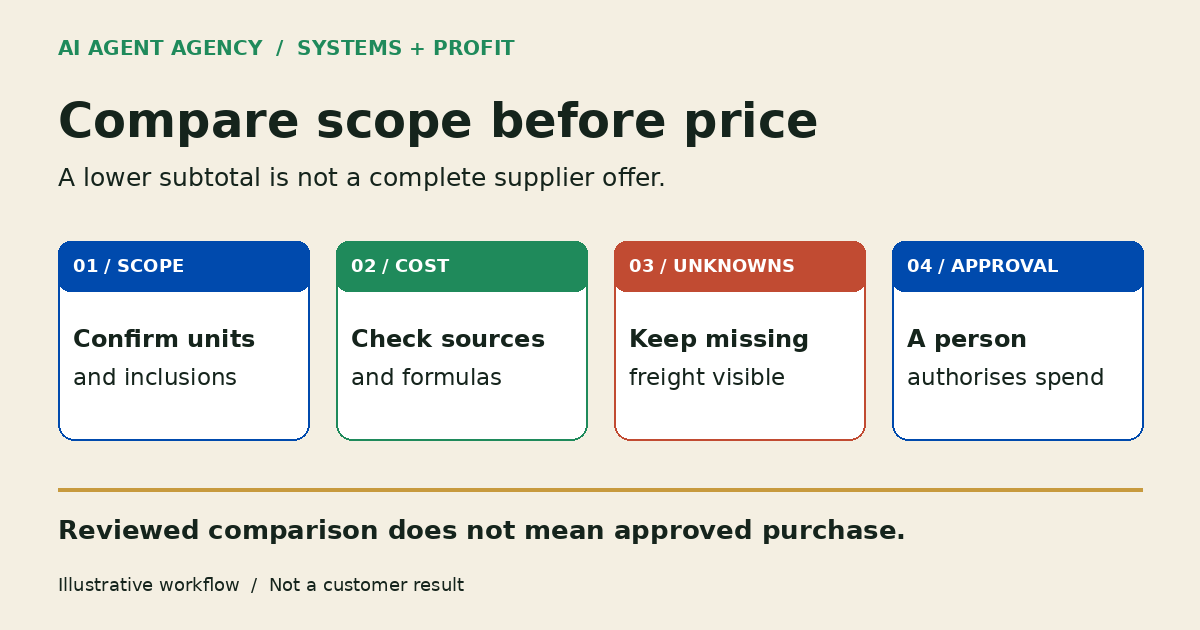
Can AI compare supplier quotes fairly?
Only compare prices after checking that each offer meets the same requirement. Ten individual items, two packs and a substituted model may look similar in a summary but describe different purchases. A blank freight field does not mean free delivery.
Agree the evaluation basis first
Write down required specifications, quantities, delivery location, acceptable substitutions and purchase authority. Decide which criteria matter before seeing prices; do not let AI invent scoring weights afterwards.
NZ Government Procurement’s evaluation-methodology guidance separates eligibility from price in its lowest-price method and describes other evaluation models. Use it as methodology inspiration, not a claim that public-sector procurement rules bind every private business.
Copy a supplier quote comparison template
Use one row per supplier and required line item in a restricted spreadsheet. Preserve the original wording alongside any normalised value. Every material entry needs a document, page, line or cell reference; otherwise record “not stated”.
| Field | What to record | Evidence or review rule |
|---|---|---|
| Identity | Supplier, quote reference, version, issue date and validity | File and page; flag expired offers |
| Requirement | Requested specification, offered item, inclusions and exclusions | Requirement ID plus quoted line |
| Quantity and unit | Offered quantity, pack size and confirmed conversion | Source line; flag uncertain equivalence |
| Money basis | Currency and quoted GST wording | Exact source; never infer tax treatment |
| Costs | Unit price, subtotal, freight and other charges | Source for each; blanks stay not stated |
| Delivery | Destination, timing, installation and conditions | Source page; separate estimate from commitment |
| Calculation | Formula, inputs, rounding and conversion assumptions | Label derived values and scenarios |
| Open questions | Missing costs, substitutions or conflicting terms | Source conflict and named clarification owner |
| Approval/status | Reviewer, next action, due date and decision reference | Unverified, awaiting clarification or reviewed; purchase approval separate |
“Reviewed” means someone checked the comparison, not that spending is authorised. Keep the approval reference separate from document-extraction status.
Four steps from mixed files to a reviewed comparison
1. Restrict and preserve the source set
Use approved document storage and the minimum necessary data. Keep original PDFs and spreadsheets read-only with version references. Exclude banking details and unrelated personal information. Check the proposed tool’s access, retention and sharing settings before uploading commercially sensitive quotes.
Start with the AI document-processing checklist if scans, missing pages or inconsistent files are the real bottleneck. Treat supplier text as evidence, never as instructions granting the agent extra access or authority.
2. Extract draft fields, then check equivalence
Ask for source references, exact quoted wording and an uncertainty status. Check scans against the original page. Flag substitutions, unmatched lines and omitted services instead of combining them into an apparently complete offer.
A reviewer confirms whether pack sizes and specifications are equivalent. Similar descriptions are not enough. Keep excluded lines visible even when they prevent a neat ranking.
3. Calculate outside the language model
Use checked spreadsheet formulas or deterministic code for arithmetic. Retain the input cells and formula trail. Separate confirmed quoted values from derived values, hypothetical scenarios and unknowns.
For foreign currency, record an approved rate source, date and conversion basis; do not silently mix currencies. Ask your finance adviser about unclear tax treatment rather than letting the model decide. An incomplete delivered cost remains incomplete.
4. Prepare clarification questions and route review
Draft specific questions: “Does this price include delivery to our stated address?” or “Does the substituted model meet specification R1?” A person reviews and sends them. Record the reply as a new source and update only the affected fields.
If a revised quote changes scope, validity or price, retain the prior version and flag the changes. Reopen the relevant review and purchase-approval steps rather than carrying old approval forward automatically.
Synthetic example: the lowest number is not a complete offer
These fictional quotes illustrate a worksheet, not customer results or live supplier offers. The requirement is ten units meeting specification R1, delivered to the buyer’s address. All amounts below are NZD excluding GST; no GST calculation is attempted.
| Offer and fictional evidence | Confirmed quoted values | Derived amount and unresolved items | Review status |
|---|---|---|---|
| A / A-v1 p1 line 1 and p2 delivery | 10 units at $120; freight $80; R1 stated | 10 × 120 + 80 = $1,280; validity not stated | Await validity confirmation; purchase unapproved |
| B / B-v2 Sheet1 B2:D2 and notes | 2 packs of 5 at $610 per pack; R1 stated | 2 × 610 = $1,220 goods; 610 ÷ 5 = $122 per unit; freight not stated | Delivered total unknown; purchase unapproved |
| C / C-v1 p1 line 1 and exclusions | 10 substituted units at $115; installation excluded | 10 × 115 = $1,150 goods; freight not stated; R1 equivalence unconfirmed | Technical and scope review required; purchase unapproved |
B’s goods subtotal is lower than A’s delivered subtotal, but those are different bases. C cannot be treated as meeting R1 merely because its price is lower. Do not rank complete delivered costs until the missing terms and equivalence are confirmed.
Do you need an agent or a better worksheet?
Check existing procurement features first. For occasional, consistent quotes, a worksheet may suffice. Consider AI only when interpretation warrants extra review and maintenance. Test authorised redacted files against independently checked answers; track missed exclusions, wrong units, missing references and correction effort.
Frequently asked questions
Can AI compare supplier quotes in PDF and spreadsheet formats?
It can prepare draft fields if the chosen tool supports those files. Check scans, formulas, hidden tabs and source references. File support does not prove the extraction is correct; compare material values with the original.
What if quotes use different units, currencies or tax wording?
Keep the original basis visible. Confirm pack conversions and specifications, document any approved currency assumptions, and leave unclear tax wording unresolved for finance review. Do not create a single comparable total from unconfirmed inputs.
Should AI fill in missing freight or choose the cheapest supplier?
No. Record missing freight as “not stated”, draft a clarification and hold the delivered total open. An authorised person chooses a supplier using the agreed criteria; the lowest visible number may omit required scope.
Can the comparison automatically create or approve a purchase order?
Not in this proposed first workflow. It prepares evidence for review only. Any later order integration needs separately agreed permissions, exact-action approval, failure handling and verification. A checked comparison does not authorise spending.
Assess your quote-review bottleneck before connecting systems
Book the NZ$1,000 AI Agent Assessment to map quote intake, source evidence, permissions and purchase approvals. Bring a blank comparison sheet and describe one recurring clarification problem. Use redacted examples through an agreed channel; do not upload confidential quotes or bank details through the booking form.
The Assessment stands alone and does not include installation or procurement advice. The recommendation may be a clearer template, an existing tool or a bounded preparation pilot—not necessarily an agent.