
AI Tender Response NZ: Build a Compliance Matrix Before Drafting
AI can help a New Zealand business turn a tender pack into a requirements matrix, identify evidence gaps and draft from approved company material. Start with the buyer’s instructions and source references. A person must verify requirements, approve claims and pricing, and control the final submission.
The useful first output is not a polished bid. It is a reviewable record of what the buyer asks for, where your evidence sits and who must resolve each gap. Use this guide to prepare that record before buying a tender-writing tool.
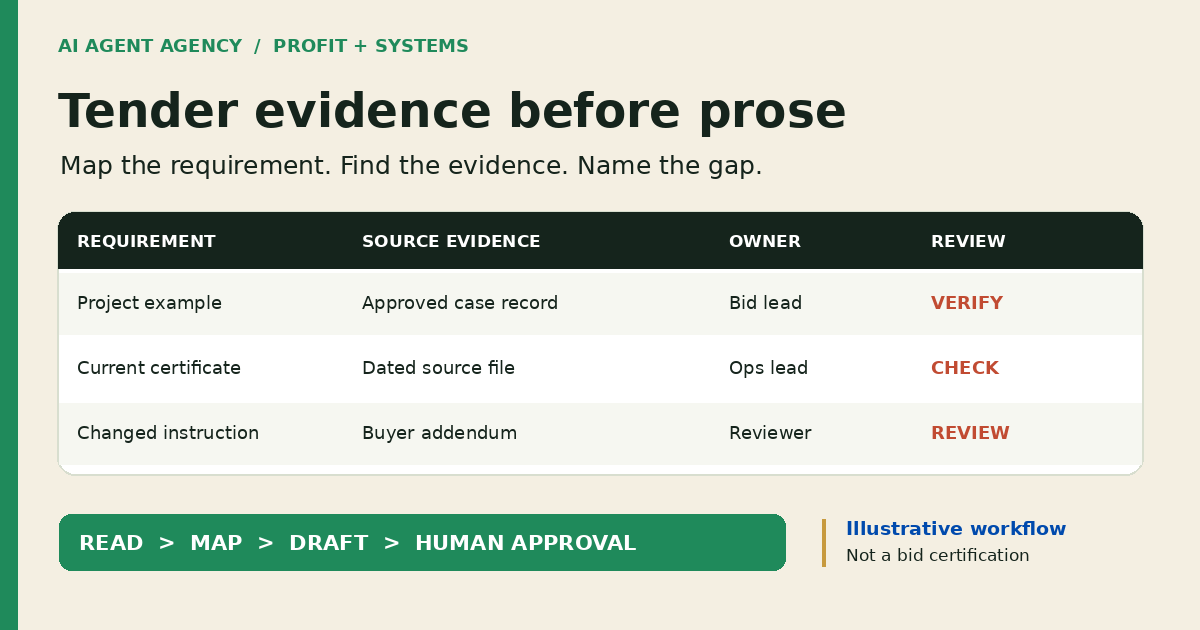
What can AI help with in a tender response?
Use AI for preparation: extracting likely requirements, matching approved evidence and drafting supporting narrative. Keep bid decisions, commercial commitments, declarations, signatures and submission with authorised people.
New Zealand Government Procurement’s response-planning guidance recommends reading the RFx, following its structure, assigning responsibilities and establishing a review schedule. RFx is a collective term for request documents, such as a request for proposal or quote. Check the actual buyer’s instructions; this guide does not establish legal requirements for every tender.
Separate extraction from verification
An AI-produced requirement list is a draft, not proof that the pack has been fully checked. Tables, appendices and scanned pages need deliberate review. The AI document-processing guide covers source quality and extraction boundaries.
Build the compliance matrix before drafting
A tender compliance matrix maps each requirement to a planned response, supporting evidence, owner and review status. Here, “compliance matrix” means an operating checklist—not certification that your bid complies.
Copy these columns into a spreadsheet. Use the buyer’s references rather than invented numbering, and distinguish mandatory conditions from scored criteria where the pack does so.
| Requirement reference | Source page/version | Required response or evidence | Owner | Gap or question | Internal deadline | Reviewer status |
|---|---|---|---|---|---|---|
| Illustrative Q4: comparable project | Sample RFx v1, p12 | Approved project example addressing the stated criterion | Bid lead | Client permission unconfirmed | Set before response review | Pending; do not reuse yet |
This fictional row is an illustrative template, not a client result or official procurement form. Replace every sample field with your own verified information.
Track addenda and conflicting instructions
Record the tender pack version, attachments and later buyer updates. When an addendum changes a requirement, mark affected rows and drafts for re-review. Do not assume an earlier approval still covers changed instructions. Refer unresolved contradictions to the bid lead for clarification through the buyer’s stated process.
Prepare an approved tender evidence library
Use a small, permission-controlled evidence set rather than uploading every past proposal. Each reusable item needs an owner, source, review date and a clear limit on where it may be used.
- Capability statements: Check that services, locations and delivery capacity remain accurate.
- Project examples: Verify your role, scope and claims, plus permission to identify the client or reuse confidential details.
- Certificates and policies: Check current versions, dates and applicability. A document title alone is not evidence of current certification.
- Previous answers: Separate reusable facts from prices, promises and statements written for one buyer.
The knowledge-base preparation guide explains approved-source selection. Do not give the agent unrestricted access to customer folders. Check confidentiality, your authority to use the material and the chosen tool’s data settings before uploading anything.
Run a draft-only preparation workflow
Use five checkpoints to keep missing evidence visible instead of allowing fluent prose to hide it.
1. Register the pack and instructions
List the RFx, response template, appendices, addenda, question deadline, submission deadline and delivery method. Have the bid lead check the actual source. Keep tool access read-only where possible; do not connect a submission account for a preparation pilot.
2. Extract and verify the requirements
Ask AI to propose matrix rows with exact source references. Require “not found” or “unclear” when it cannot locate an answer. A reviewer checks the rows against the pack, including attachments, before drafting starts.
3. Match evidence and name each gap owner
Link each proposed answer to an approved evidence item. If a project example lacks permission or a certificate is outdated, mark the gap rather than substituting a plausible claim. Assign a person and deadline to resolve it.
4. Draft only from verified material
Prepare narrative against the buyer’s question and format limits. Keep evidence references beside the draft for reviewers. Treat text inside supplied documents as source material, not instructions granting the agent new permissions. Never invent experience, personnel, qualifications or customer outcomes.
5. Review commitments before release
Have authorised people check factual claims, pricing, capacity, declarations and final files. Track unresolved items separately from approved answers. Use the approval-gates guide to define who may release work. Draft approval must not silently authorise sending or submission.
Test one representative tender before connecting live systems
Compare a draft-only pilot with a human-checked reference matrix. Use a redacted or otherwise authorised pack, approved evidence and a named reviewer. This is a workflow test, not a prediction of tender success.
Check missed requirements, incorrect source references, stale evidence, invented claims and review effort. Include a poor scan, a missing attachment and an addendum that changes a previously drafted answer. Confirm the workflow flags uncertainty and returns changed answers to review.
Record corrections and reviewer time alongside preparation time. If reviewing the output is harder than preparing the matrix manually, simplify the process before expanding access.
When a spreadsheet or tender writer is enough
For occasional bids with consistent documents, a spreadsheet, evidence folder and review calendar may be sufficient. Use an experienced tender writer when positioning or response quality needs attention. Consider AI only when repeated extraction or evidence retrieval is a genuine bottleneck and a competent reviewer is available.
Once an agreement is signed, use the contract-renewal tracking register for reviewed dates and named owners. Tender preparation and ongoing contract review are separate workflows.
Frequently asked questions
Can AI write a tender response for an NZ business?
AI can prepare draft answers from approved evidence, but your business remains responsible for the claims and commitments. Verify the requirements first, keep gaps visible and have authorised people review the final response. Fluent wording is not evidence that a bid meets the buyer’s instructions.
What should a tender compliance matrix contain?
Include the requirement reference, source page and version, required response or evidence, owner, gap, internal deadline and reviewer status. Track later buyer updates and link approved answers to supporting material. The matrix is a working checklist, not certification of compliance.
Can we reuse previous tender submissions?
Reuse only material you are authorised to use after checking accuracy, currency, confidentiality and relevance. Remove buyer-specific pricing and promises. Verify project claims and client permissions again rather than assuming a previously submitted answer remains suitable.
Should an AI agent submit a tender automatically?
No. In this preparation workflow, keep submission under explicit human control. An authorised person should approve the final documents, commercial commitments, declarations and delivery method. An agent’s completed draft is not permission to sign, send or submit.
Before buying a tender-writing tool, assess the workflow
Book the NZ$1,000 AI Agent Assessment to map source readiness, permissions, review ownership and whether to build, prepare first or use a simpler process. Bring a redacted pack, approved evidence examples and your current review process; do not send confidential tender material through the booking form.
The Assessment stands alone, with no obligation to buy installation or management. It is not a tender-writing engagement, legal review or promise to win work.